
Renata Jamrichova continues her recovery from a serious ACL and knee injury. We examine her surgery, rehab progress and possible return to tennis in 2026.
By Slice Powers / August 27, 2026
For one of Slovakia’s brightest young tennis prospects, the past year has been less about rankings, results and breakthrough wins than about patience.
Renáta Jamrichová has not played a competitive match in 2026 as she continues her recovery from the serious right-knee injury suffered in Portugal last September. The 19-year-old is hitting again and rebuilding her tennis workload, but evidence from a revealing June interview suggests that a competitive comeback was never as close as her return to the practice court might initially have indicated.
Nearly a year after the injury, the most important conclusion is also the simplest: Jamrichová appears to be progressing, but there is still no confirmed date for her return to tournament tennis.
A Season Ended in a Single Point
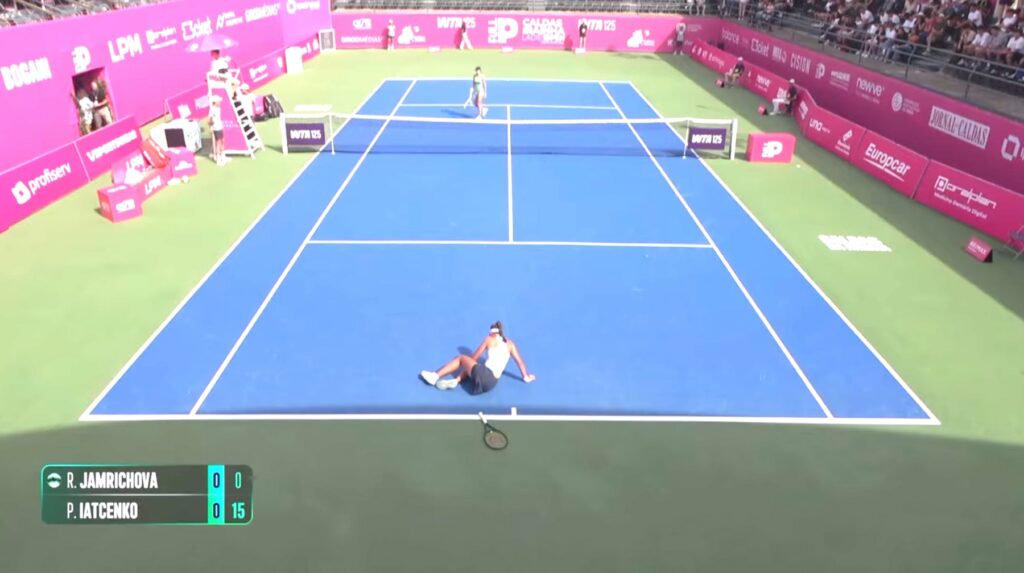
Jamrichová’s injury occurred on September 19, 2025, during the quarterfinals of an ITF event in Caldas da Rainha, Portugal. Facing Polina Iatcenko, the Slovak played only the opening point before injuring her knee and being unable to continue.
The scene was immediately concerning. Jamrichová had to leave the court in a wheelchair, bringing an abrupt end to a period in which her professional career had been gaining momentum. She was ranked No. 229 at the time and had recently reached the semifinals of the WTA 125 event in Ljubljana.
What initially registered publicly as a knee injury later proved to be far more substantial.
The Full Extent of the Damage
Speaking in a Slovak tennis podcast recorded on June 5, Jamrichová explained that she had completely torn her anterior cruciate ligament. Both menisci were also torn, while another ligament on the side of the knee had suffered damage as well.
The scale of the injury meant surgery was unavoidable. Jamrichová said doctors initially had to decide whether the repairs would require one operation or two, while swelling and bleeding inside the knee meant the procedure could not take place immediately.
She ultimately waited approximately a month before undergoing surgery in October 2025. The operation was successfully completed in a single procedure.
There was at least one encouraging aspect to an otherwise grim diagnosis. Both damaged menisci were repaired rather than partially removed, preserving the tissue, while the other damaged ligament was also repaired. Her ACL was reconstructed using a graft taken from the quadriceps tendon.
For a professional tennis player, that combination matters. An ACL reconstruction by itself demands a long rehabilitation. Add repairs to both menisci and another ligament, and the return-to-play calculation becomes considerably more complicated than simply waiting for the reconstructed ACL to heal.
Why the June Interview Was So Revealing
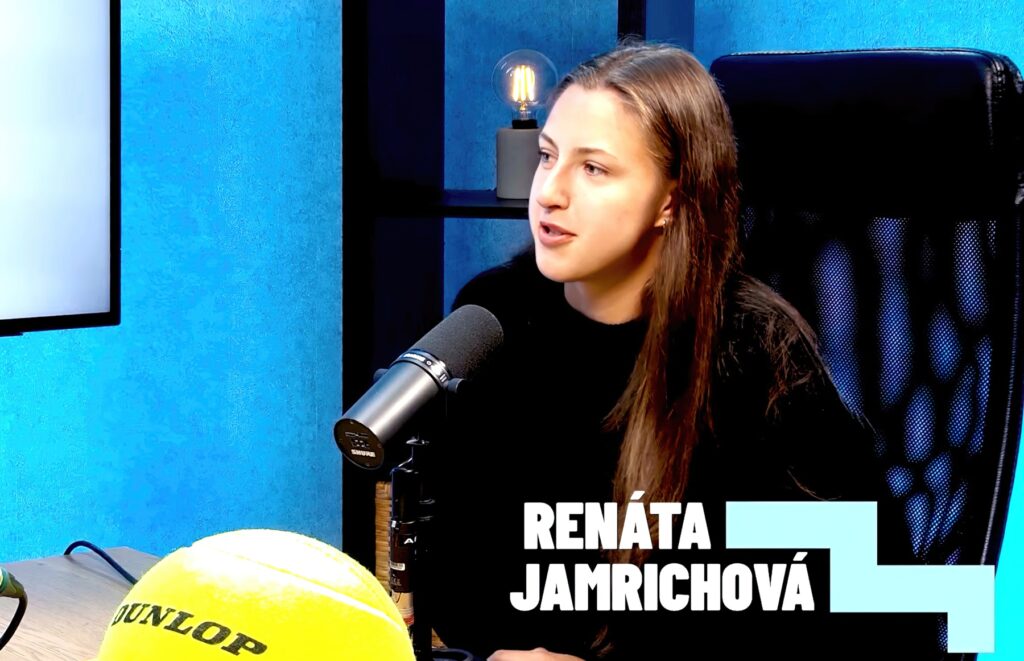
The timing of Jamrichová’s interview allows us to place her recovery in unusually clear context. During the conversation, the presenters discussed Alexander Zverev’s Roland Garros semifinal against Jakub Mensik as it was taking place. That match was played on June 5, 2026.
Jamrichová was therefore speaking roughly seven and a half months after surgery.
On the surface, her update sounded extremely positive. She said she was once again playing tennis around five times per week while continuing extensive physiotherapy, gym work, running and conditioning.
But one detail was far more significant than the number of tennis sessions she was completing: she was not yet playing full competitive points.
Jamrichová explained that she still could not play a normal training set and was not yet operating at complete intensity. She described the rehabilitation as being on the right track but acknowledged that rebuilding the muscle lost during the layoff would take time.
That distinction is crucial. Hitting tennis balls five days per week is not the same as being ready for professional tennis.
Hitting Is One Thing, Competing Is Another
Tennis places unusual demands on a reconstructed knee. A player must repeatedly brake, rotate, push laterally, recover from wide positions and change direction instinctively, often under fatigue. Those movements become considerably more demanding when points are unpredictable rather than controlled by a rehabilitation drill.
That is why Jamrichová’s inability to play points in early June was an important marker. She had progressed beyond basic rehabilitation and into tennis-specific training, but she had not yet reached the final competitive stage of the return process.
Before a tournament comeback, the logical progression would include unrestricted movement, live points, full practice sets and eventually repeated match-like workloads. The knee must tolerate not simply one good session, but the cumulative stress of professional competition.
Given the complexity of Jamrichová’s injury, there is little reason to rush any of those stages.
No Matches Yet in 2026
The WTA’s current records underline just how cautiously the comeback has been handled. As of August 27, Jamrichová remains listed as inactive and has a 0-0 competitive record for the 2026 season.
Her most recent official singles ranking is No. 604, published on August 24. That number is dramatically lower than her career-high ranking of No. 217, but it should not be interpreted as evidence of declining ability.
The ranking slide is largely a consequence of inactivity. Jamrichová has been unable to replace points earned during her rise through the professional rankings, while continuing to lose older results from her ranking total.
Her most recent competitive appearance remains the September 2025 event in Portugal where the injury occurred.
A Comeback That Has Taken Longer Than It First Appeared
When Jamrichová described playing tennis five times per week in June, it would have been understandable to assume that a tournament return might follow during the summer. Nearly three months later, that has not happened.
That does not necessarily indicate a setback.
There has been no verified public report of a new injury or a failed rehabilitation. Instead, everything we know is consistent with a team taking a conservative approach to a young player recovering from a multi-structure knee injury.
At 19, Jamrichová has far more to gain from returning properly than from returning quickly. A few extra months away from competition are insignificant compared with the consequences of asking an inadequately prepared knee to absorb the demands of professional tennis.
When Could Jamrichová Realistically Return?
No official comeback date has been announced, so any projection must be treated as an estimate rather than a confirmed schedule.
Based on the stage of rehabilitation Jamrichová described in early June and the fact that she has still not competed by late August, a return during September or October would appear more realistic than the summer comeback that once seemed possible.
That would place her approximately 11 to 12 months beyond surgery. A return later in the autumn, around November, would take the rehabilitation closer to 13 months.
None of those time frames would be particularly alarming considering what had to be repaired. Jamrichová did not suffer an isolated ACL rupture. Her knee required reconstruction of the ACL alongside repairs to both menisci and another ligament, and she has spoken openly about the substantial muscular atrophy created by the prolonged period of reduced activity.
The Ranking Can Wait
There will inevitably be concern when a former world No. 217 falls outside the top 600 before her 20th birthday. In Jamrichová’s case, however, the ranking is currently little more than background noise.
This remains the player who won the girls’ singles titles at the 2024 Australian Open and Wimbledon, collected the Roland Garros junior doubles crown and began establishing herself as one of Slovakia’s most promising young professionals.
She had already demonstrated that she could translate junior success into the senior game. Before the injury, her trajectory was unmistakably upward.
The challenge now is not recovering those lost ranking places as quickly as possible. It is ensuring that when Jamrichová returns, she has the physical confidence to play the aggressive, explosive tennis that produced that rise in the first place.
Patience May Be the Most Important Part of the Comeback
There is something frustrating about Jamrichová’s situation because the injury arrived precisely when her professional career was beginning to accelerate. At the same time, that makes caution even more important.
A rushed comeback might satisfy the understandable desire to see her competing again, but there is no meaningful prize for returning a month early. For a 19-year-old whose best tennis should still be years ahead of her, the objective has to be durability rather than immediacy.
The encouraging news is that by June she was already back on court, training regularly and describing the rehabilitation as progressing well. The less glamorous reality is that returning from an injury of this magnitude requires more than being able to hit a tennis ball without pain.
Until Jamrichová begins playing unrestricted points and full practice matches, any tournament date remains speculative. The first appearance of her name in an ITF or WTA draw will therefore carry far greater significance than her current ranking suggests.
For now, the comeback remains unfinished. Considering what happened to her knee last September, that may be exactly how it should be.